
Service Strategy
for Heartfulness
This project is an extension of the academic dissertation carried out during my Masters at Brunel University London. It showcases key strategic recommendations prescribed for the NPO promoting mental wellness for its effective and efficient working in the short and long run.
Client
Heartfulness
Year
2022
Category
Mental Wellness
Type of Work
Service Planning
Strategic Branding
Design Thinking
Despite the fact that people's mental health had been declining at alarming rates (according to the WHO), the needs remained unmet for a long time due to the stigma associated with mental health.
This unmet demand was made clear by the recent COVID-19 pandemic as more and more young people began to embrace this vulnerability as "strength" through the use of digital media. It also resulted in lifestyle changes for prospects, transforming their views towards organisations, instilling value-based thinking, and encouraging a more radical approach to decision-making.
Heartfulness is a NPO offering a wide range of mental well-being approaches as well as lifestyle techniques. It offers science-based meditation and relaxation practices catering to broad demographics and is applicable to everyone across the globe, regardless of their culture, religion, country, etc. Since COVID-19 pandemic, this organisation has been rapidly launching numerous initiatives to spread awareness about its offerings among its broad target audience on all levels.
These initiatives also supported in providing solutions for the major global challenges such as intensifying climate crises, need for humanitarian aid etc. Due to a lack of trained knowledge and resources (for a NPO), the organization's rapid global expansion has resulted in unconnected and autonomous activities.
Working with Heartfulness and conducting an extensive literature analysis and exploratory interviews with management of Heartfulness presented me with some valuable insights. I believe that in current times, where younger generations are adopting healthy lifestyle and making conscious choices in order to live a balanced life, addressing these requirements will help Heartfulness remain relevant and significantly improve the lives of its users. I intended that the major goal of this project would be to explore the potential to improve and innovate the functioning of this organisation based on constructive insights gained through utilising design thinking and the extensive research data.
Overview
A Framework with the help of the Double-Diamond process and an extensive literature studies has been constructed to maximise the impact of Heartfulness on its target audience. It is to be followed by the management of Heartfulness to understand and cater to their target audience better.


4 Strategic Recommendations
1.
Categorisation of target audience for better reach
Problem:
Inadequate reach
Recommendation:
Redefining Target Groups
Outcome:
Focussed broadcasting/messaging and increased impact of brand messaging/ initiatives on the audience
3.
Enhancing brand perception by establishing an effective communication strategy
Problem:
Communication gap between HFN and younger audience
Recommendation:
A defined Brand Voice
Outcome:
Creating impact by producing highly relevant content with the younger audience
2.
Strategic repositioning
for differentiation
Problem:
Drowning in saturated market of
mental wellness
Recommendation:
Repositioning by upgrading its brand communication
Outcome:
Stand out in the market by transforming into a brand catering to younger generation's values and beliefs
4.
Volunteer Management
Problem:
Lack of skilled expertise and resources
Recommendation:
Effective volunteer acquisition and retention strategy
Outcome:
Organisation's sustainability in the
long run
TL;DR Design Process

I chose to follow a methodical design approach to explore opportunities in my interest areas of mental well-being and design thinking. The Double Diamond design process by Design Council was I believe, best suited for this project due to complementary effect of divergent and convergent thinking processes.
Stage: Discover
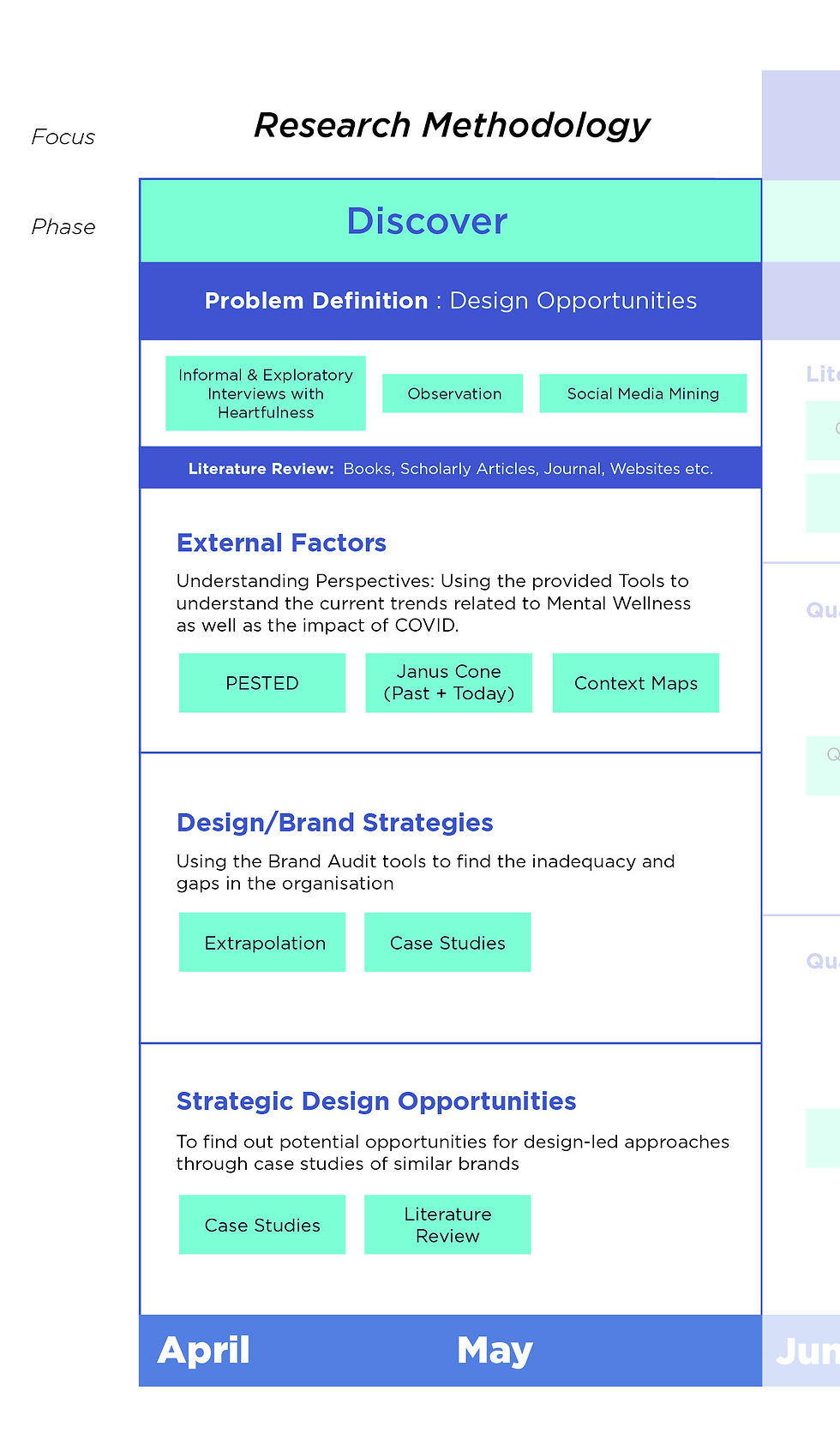
I initiated the ‘Discover’ stage by keeping a broad KRQ in mind for direction, and conducted an exploratory literature review to understand and specify the project’s scope. During the ‘Define’ stage, I conducted questionnaire surveys and closed interviews with main stakeholders of the organisation, in order to narrow down and define the key issue. To capture the holistic perspective, I interviewed regular as well as non-practitioners to understand their current experience with Heartfulness and the interviews with their management helped me understand the challenges faced while launching new initiatives.


Conclusion & Strategy for next stage
The major takeaways I inferred after conducting the exploratory research are as follows:
1. Setting the Context
The purpose of the brand should be communicated clearly and should be infused in every action/step the brand takes.
2. Relevance
Creating content catering to the target audience by understanding what they are dealing with and what they are trying to achieve from the brand and addressing their challenges through the brand.
3. Tone & Content
The content produced by the brand should be easily consumable and should be understood easily by targeted audience. Strategic planning of the tone of communication used throughout the brand will help avoid confusion.
4. Design Usage & Consistency
Use of design and strategic planning to ensure consistency throughout the customer touchpoint. This puts the the brand together and creates a specific brand personality.
In order to understand the nature of these research areas from a human perspective, I decided to gather direct evidence to ensure relevance of the compiled data.
I decided to conduct an in-depth secondary research by reviewing various case studies concerning the major takeaways from the literature review. I came across some super useful insights which helped me understand how benchmark brands had already accomplished these desired outcomes. I also conducted questionnaire surveys and personal interviews to bring data to life. These insights helped with putting things into perspective and aided with filling the gaps between the recorded data.
Stage: Define
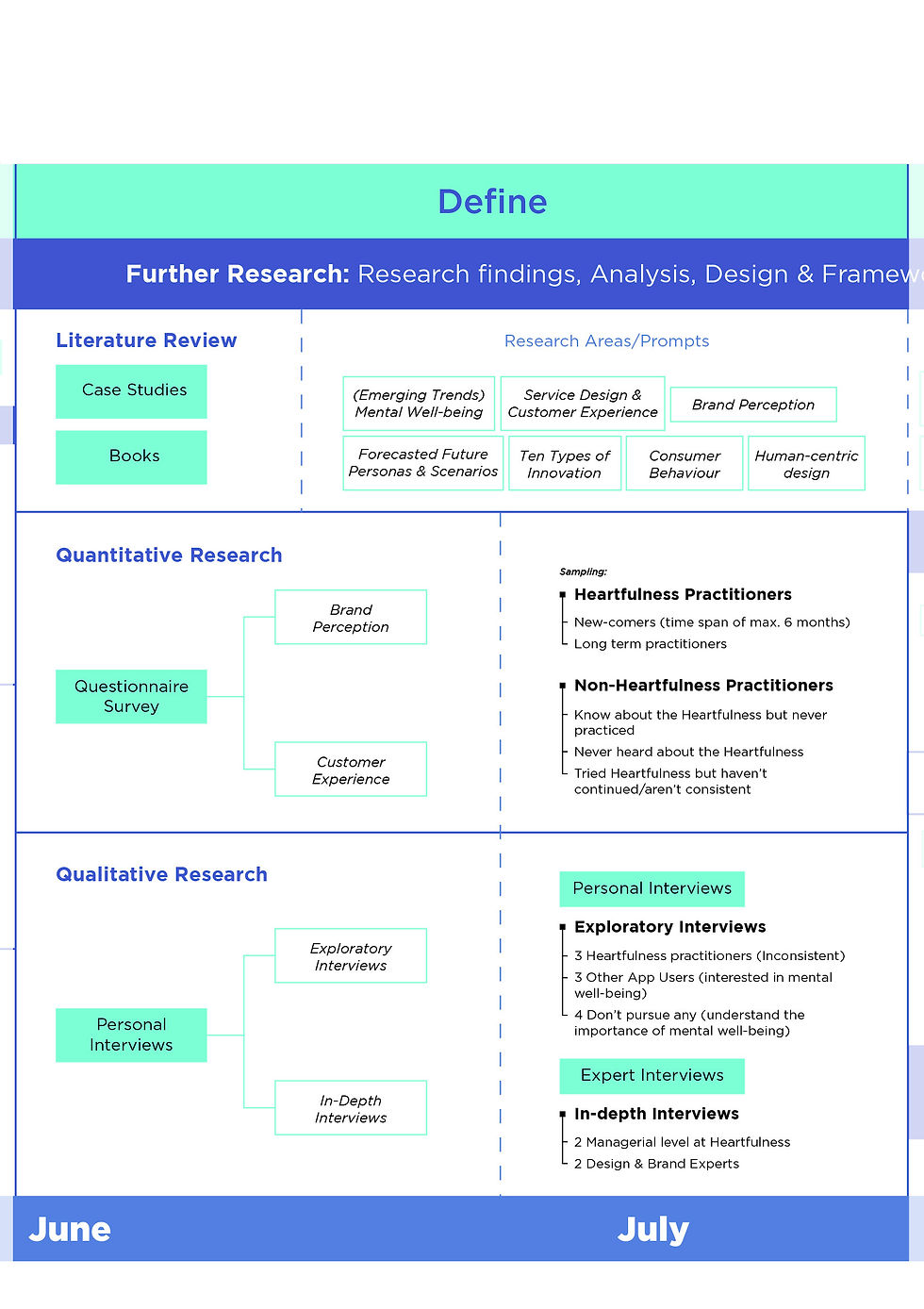


I observed that Heartfulness presented an innovative approach to address a common root cause of all these problems, despite offering a variety of meditation techniques for addressing a variety of problems. People were to adopt this strategy into their daily lives, which would subsequently aid in resolving other problems stemming from this root cause.
It was a well-known fact among all the participants (even those without any meditation experience) about the importance of meditation and faced difficulty prioritising it. From the interview insights, I recognised that only regular Heartfulness practitioners were able to meditate regularly ultimately helping them improve the quality of their life. As a result, I focused on both the want and need for individuals to regularly practise meditation and Heartfulness's innovative approach, which is designed to be incorporated into daily life.
I tried to represent meditation experience of the participants through slider scales as well as to understand the level of prioritisation given to meditation, despite of understanding the importance of meditation.


Stage: Develop

The goal for this stage was for me to explore and find ways to resolve the identified gaps and issues faced by the organisation. I chose to use user centred design tools to represent this valuable data, for the organisation to understand their users and make informed product and marketing decisions.
Prototype coming soon ...